Lab / BETA / Updated May 17, 2026
AI Interviewer
Reimagining the top of the hiring funnel with AI voice agents that screen and interview candidates — getting more candidates through the door while freeing recruiters to focus on evaluation, assessment, and the human judgment calls that actually drive talent decisions.
- OpenAI Realtime
- Voice Agents
- Hiring
- Recruiting
What it solves
The first round of any hiring process is the most expensive bottleneck in talent acquisition. Recruiters spend hours on initial phone screens — running the same intro questions, capturing the same basic context, and triaging candidates who could have been qualified (or disqualified) in fifteen minutes of structured conversation. The cost isn't just time. It's funnel compression: the candidates who never get a callback because the team can only screen so many people in a week.
AI voice agents change the shape of that funnel. Instead of rationing recruiter time across a short list, a voice agent can run a structured, conversational screen with every applicant who reaches the top of the pipeline — 24/7, in minutes rather than days. Recruiters get back transcripts, scored responses, and a clear signal on who's worth a deeper conversation. The hours saved get reinvested where they matter: candidate evaluation, calibration with hiring managers, and the relationship-building work that algorithms can't do.
How it works
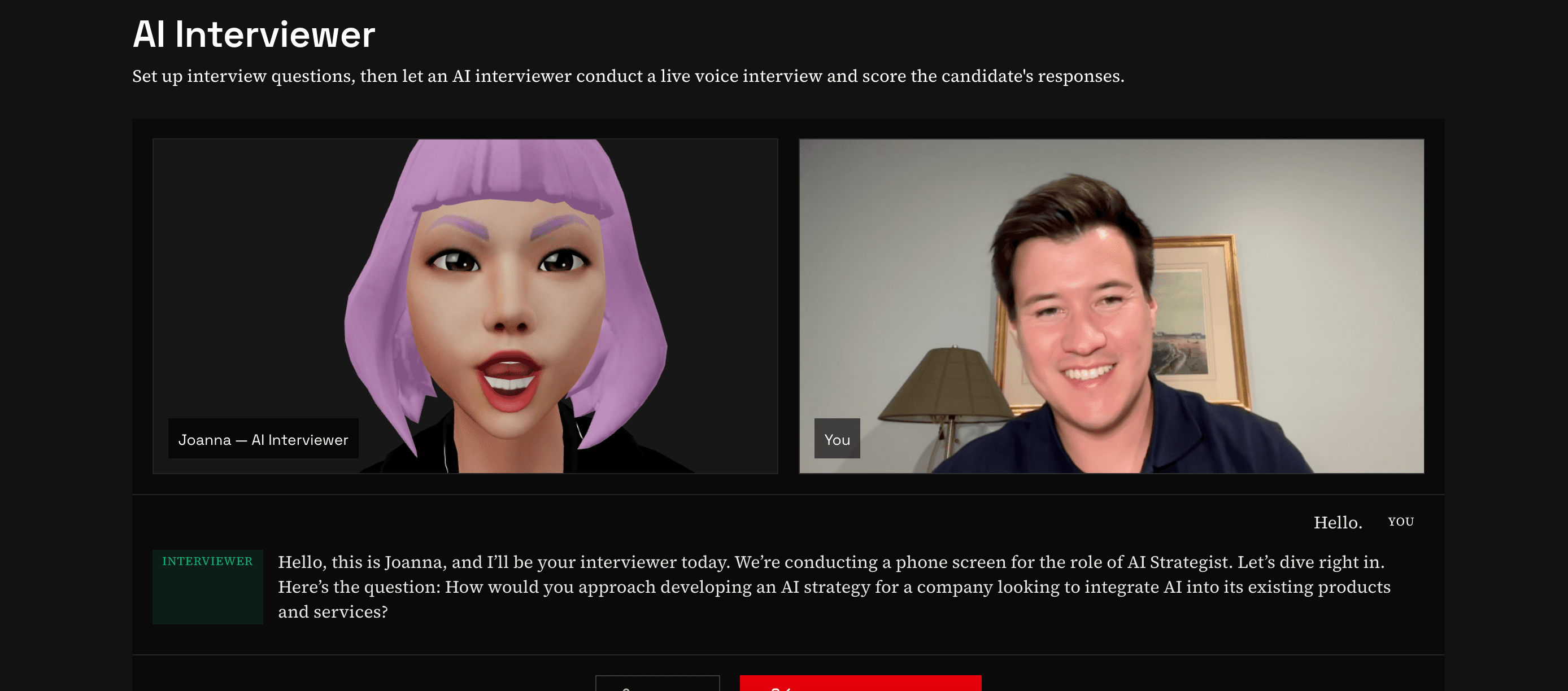
The experiment runs a live voice interview powered by a realtime AI agent:
- Configure the interview by defining the role context and the questions the agent should ask. The setup mirrors the recruiter's screening script — but encoded once and run consistently across every candidate.
- Conduct the interview with a voice agent that introduces itself, asks the configured questions, listens to the candidate's responses, and asks natural follow-ups when something needs clarification.
- Score the responses against rubric criteria, producing a per-question evaluation plus an overall recommendation. Every response is tied back to the transcript so the reasoning is auditable.
- Hand off to the recruiter with a structured report — transcript, scores, and standout moments — ready for human review rather than human transcription.
The candidate experience is conversational, not robotic. The recruiter experience is curated, not exhausting.
Why it matters
- More candidates, same headcount. A team of three recruiters can effectively triage the volume of ten when the first conversation is handled by an agent.
- Consistency at the top of the funnel. Every candidate gets the same questions, asked the same way, scored against the same rubric — reducing the noise that creeps in across hundreds of unstructured phone screens.
- Higher-leverage recruiter work. The hours that used to go into intro calls move upstream into sourcing strategy and downstream into candidate evaluation, hiring manager calibration, and offer conversations.
- Better signal for hiring managers. A scored transcript beats a hallway summary. Decisions get made on evidence, not vibes.
Ideal for
- Talent Acquisition Leaders rethinking the economics of high-volume hiring.
- Recruiters drowning in initial screens and looking to reclaim time for assessment work.
- Hiring Managers who want a consistent, evidence-based view of every candidate that reaches them.
- People and HR Strategy teams exploring where AI agents can responsibly take work off the plate without compromising candidate experience.
A note on the human side
This isn't an argument for taking humans out of hiring. It's the opposite. The judgment calls that matter — culture fit, growth potential, what a person could become inside a team — still belong with humans. The premise here is that AI handles the repeatable, structured layer so recruiters can spend more time, not less, on the parts of hiring that actually require a person.
Try it out
An AI voice agent that joins meetings by phone, listens to the conversation, and speaks when addressed — just like a real team member. Searches the web in real time and sends recap emails on request.
Paste a job description and instantly see how much of the role can be addressed by AI and automation — with a scored report, actionable reasoning, and an annotated view highlighting automatable and augmentable responsibilities.